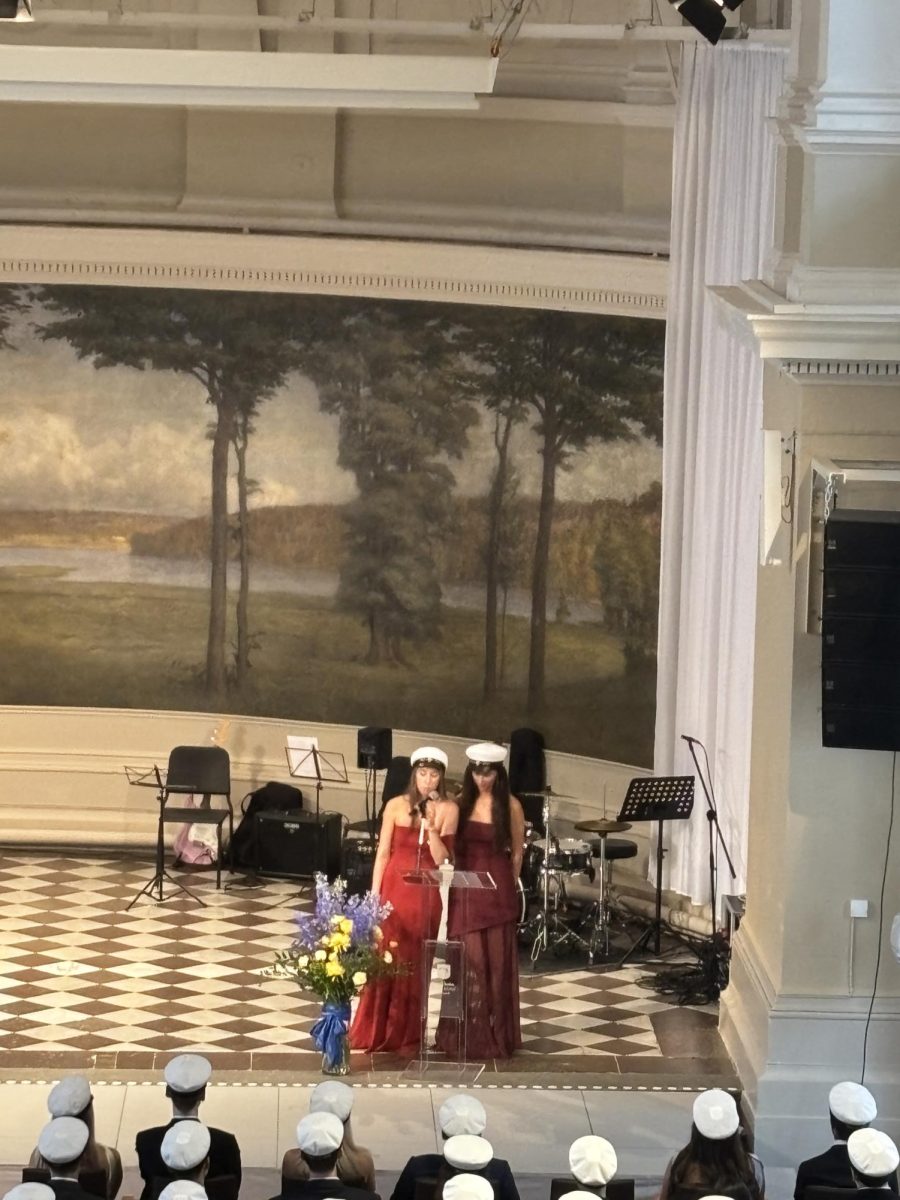
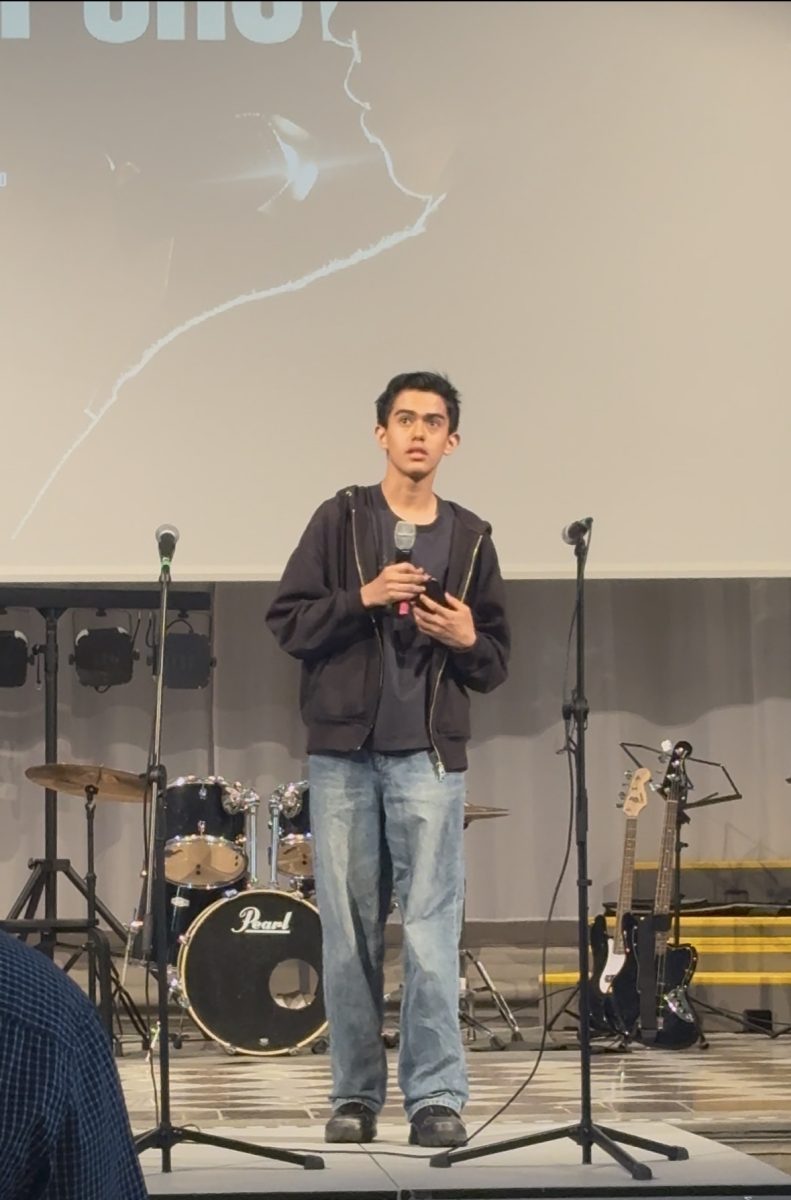
On Thursday the 9th of October, SIS welcomed Her Excellency Ambassador Barbara Jones, Irish poet Dr. Gail McConnell from Queen’s University, Belfast, as well as Maria Zirra, a postdoctoral researcher at the English Department at Stockholm University. When entering the room, students were greeted with Irish music and saw the grand and illuminated pedestal standing in the middle of the stage, surrounded by flags of Ireland, Sweden, and the European Union. This welcoming atmosphere created a sense of excitement within the students who were ecstatic to hear what was yet to be said. Victoria Maurell presented Mid Term Break, while Charlotte Darrigade shared The Blackbird of Glanmore, and finally Carl Hajman read out one of McConnell’s many untitled poems. At the end of the event, ten minutes were allocated to student questions regarding Heaney and McConnell ‘s poetry, discussing themes of timelessness and the nation’s history.
Before discussing the impact or legacy of Irish poetry, a range of factors should be considered and context given as there is a prominent theme of violence, and a heavy influence of what is known as the period of ‘The Troubles’, found in Heaney’s writing. Although the Irish war of independence was fought from 1919-1921, the armistice did not mark a clear end to violence between the North and the rest of the nation. In the late 60s, a severe sectarian conflict started, lasting an overwhelming 30 years and causing fear within inhabitants due to bombings and attacks. Being born and raised during this time, Seamus Heaney was heavily impacted by this period of brutality and is something which has scarred him as reflected in the multitude of poems influenced by The Troubles.
The talk started with an extraordinary explanation on the events leading up to Heaney’s fame and what allowed him to gain the 1995 Nobel prize in Literature, shared by Her Excellency Ambassador Barbara Jones. This sparked interest within the students who were intrigued by who this man truly was and how his poetry had such an everlasting impact on the nation who, to this day, still idolises Seamus Heaney and his works.
The event continued, and the audience was given the privilege of seeing one of Ireland’s emerging poets present her mindset and book. Gail McConnell, born 1981 in Belfast, Northern Ireland, has written the book The Sun is Open, published in 2021. The same book has just this year been published in Swedish; Solen står på glänt. The book describes when her father was murdered by the IRA (Irish Republican Army), an event she witnessed as a three-year old, and explores her identity being shaped by what she witnessed and went through as a child and young adult; the aftermath of The Troubles. McConnell told the audience the journey of writing the anthology. Due to her age at which she lost her father, she does not remember much of him, or his violent passing. Some fragments of an image remain, however the full picture was incomplete. Scavenging through boxes in her attic, she found remains that gave her pieces of the bigger puzzle that was her father, and his life both personally and as a part of the history of Northern Ireland. Newspaper titles, articles and images cut out and saved, and memories from her childhood. These were the artifacts McConnell used to bring about the story of her father, and along with her own life memories, the remarkable The Sun is Open, came about. Dr. McConnell’s words formed a highly moving story, and showed how poetry can be a beautiful way of storytelling and of processing storytelling. Sitting in the audience one could sense her remarkable way with words, and students and teachers alike were fascinated by her story and what she had found to be her purpose through her journey as an author.
One of the highlights of the day was when three students read a poem each; two by Seamus Heaney and a Swedish translation of one by Dr. McConnell. Victoria Maurell commenced with Mid Term Break, an extremely significant poem to her as it describes Heaney’s loss and experience of grieving his younger brother, who died in a tragic car accident when he was only four, Heaney being 13 at the time. During an interview she shared with us “I relate to this poem because I also have two younger brothers, who to me, are some of the most significant important people in my life, they’re a constant in my life, and two people who I know I will always be able to count on even when everything else in my life changes”. This loving relationship towards her brothers was reflected in her affectionate and tender reading of the poem, making everyone in the room feel the emotions Heaney must have felt when writing. Charlotte Darrigade then shared The Blackbird of Glanmore with the audience, creating a mournful atmosphere through her lugubrious tone utilised to convey the writer’s grief after the loss of his brother which left him bereft. The poem is an extended metaphor in how he sees his brother, “He is joyful and ‘jittery’ at first, but leaves so suddenly.” as Charlotte Darrigade describes it. Heaney sees his brother as a blackbird. To her, it was “interesting to read poems outside of [her] English class context without the pressure of analysing it but to also have my own interpretation of it.”. Finally, Carl Hajman recited Gail McConnell’s poem in Swedish translation, a brutal and powerful poem, highlighting that violence was prevalent in her childhood.
As the session evolved, Maria Zirra was given the chance to share with the students and teachers an in depth analysis of Heaney’s poem ‘The Tollund Man’. Currently studying war poetry in DP1 this analysis allowed the 11th graders to gain an insight on how to successfully deconstruct sophisticated poetry; crucial and valuable analysis skills required in all their papers and orals. The poem explored the violence and sacrifice in the Iron Age in Denmark as well as during Northern Ireland’s political disturbance throughout The Troubles. The poem depicts the timelessness of violence and how it can be perceived as a repeated pattern in almost every aspect of global history as seen in the Danish and Irish relevance.
Towards the end of the presentation and after the recitation of the poems, the floor was opened for students to ask questions to any of the three impactful women regarding Heaney, Gail McConnell’s poetry, or even Ireland’s history. The session started off with the question “Why and how is Heaney’s writing timeless in the context of Ireland and its history?”, though all 3 presenters gave 3 impeccable answers, Poet Dr. Gail McConnell, shared a perspective which the grade 11 students found fascinating and extremely valuable in regards to their Individual Orals. McConnell expressed Heaney’s ability to address relatable issues in relevant ways for each and every individual, making his poetry applicable regardless of the years that have gone by or place it is being read in. Childhood is another recurring theme which is visible in the Nobel laureate’s writing, all those who have experienced this infancy or even adolescence are able to see themselves reflected in Heaney’s poetry. The universal ‘coming of age’ feeling will never cease to infiltrate us as individuals, and will always be something that readers from all over the world and of all ages can relate to on a personal level.
Overall, this experience has allowed students to expand their knowledge on Irish literature and history, giving them the opportunity to gain an insight into the reality of living through violence. Not only does Heaney convey a message of hope by asserting that poetry allows individuals to get through times of struggle by easing the pain, but also acknowledges the traumatic experiences endured by the Irish. The grade 11s left the room on Thursday with brand new perspectives and knowledge that will be pivotal in both the Literature and the Language & Literature courses.