Over the last decade, the manipulation of truth, authoritarianism, surveillance, and censorship have become norms, making modern societies seem like examples drawn from some of the finest dystopias of classic literature. George Orwell’s 1984, originally published in 1949, has left a profound legacy in many areas, including culture, politics, and language. In fact, according to Buzzfeed News, the book’s sales rose by over 9500% in 2017 following severe political tension in the United States, and even became a top-selling book in Russia, suggesting that its message remains relevant.
By leaving an immense impact linguistically, its iconic terms and references have become a part of contemporary lexicons. Although it remains a classic novel, the plot has been adapted into a famous reality TV show that embodies the oppressive nature of the party by monitoring its participants and repeating the iconic line “Big Brother is watching you”. The timelessness and literary perfection of the novel have allowed it to gain its spot in many curricula across the world. At SIS, 1984 has been selected as an HL novel in the DP Language and Literature course due to its thematic complexities and philosophical concepts. The Spirit Fund gave the grade 9, 10, and 11 students the opportunity to experience an incredible theatrical adaptation of this book.
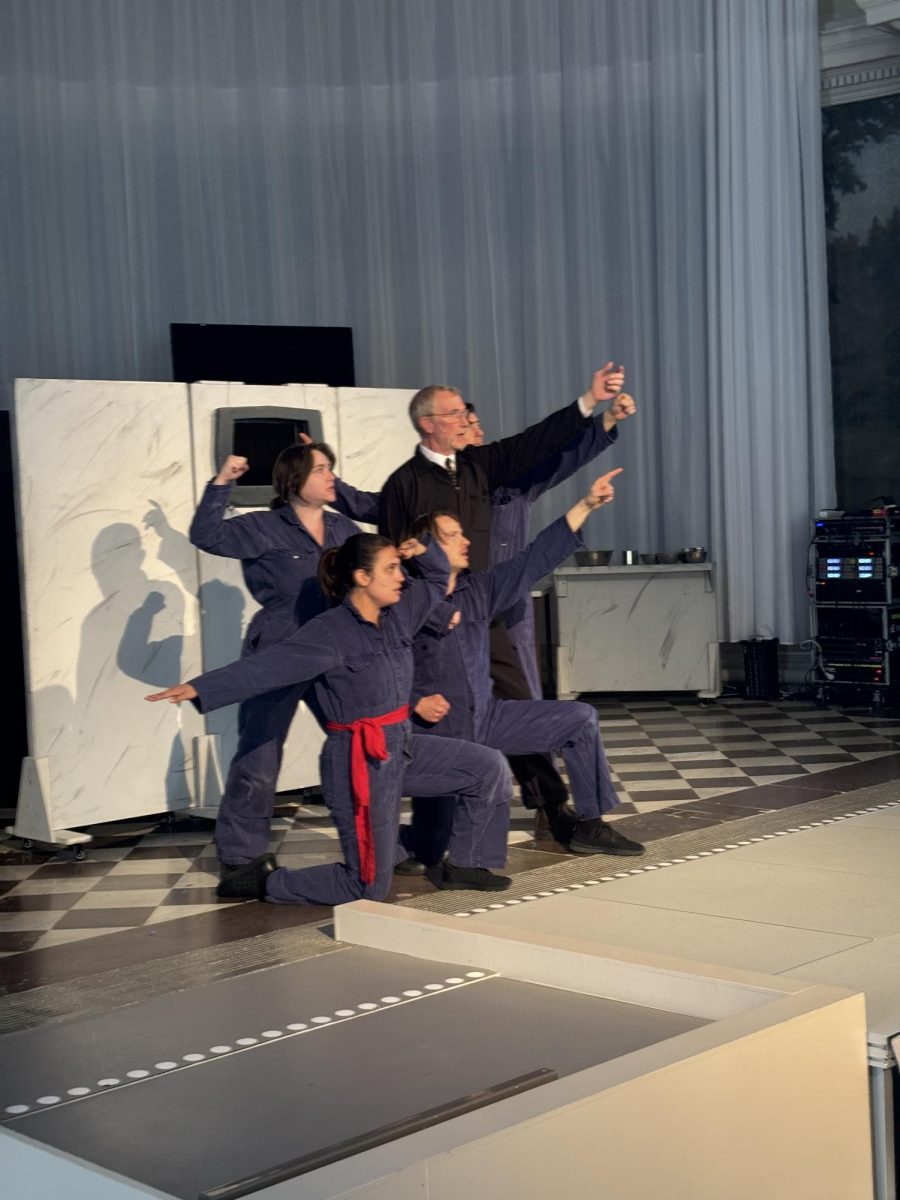
The set was simplistically yet accurately decorated, truly transporting the students, or “party members”, to Oceania’s totalitarian world. Boards draped in white were situated in the middle of the stage, including the iconic ‘Ingsoc’ [English Socialism] logo and a telescreen above.
The play strikingly commenced with the novel’s closing scene in the notorious Room 101, where the protagonist, Winston, was violently whipped before being tormented by rats. The story then went back to the start of chapter 1 and followed the chronological order of the novel, creating a full circle moment towards the end when Winston found himself in the room once again. Michele C., who has previously read 1984, felt “It was really striking how the atmosphere of fear and conformity was translated on stage, it made it easier to understand just how oppressive the world of the novel is.” Of the actors, he said, “Their performances made the characters feel believable and emotionally engaging, especially in such a heavy and complex story.”
A central theme of 1984 includes the banishment of sex for reasons other than reproduction; certain references in the play evoked laughter amongst the grade 9s who enjoyed the romantic rebellion between the protagonist and his lover, Julia. With many students set to read the novel in the upcoming year, they seemed to be able to grasp the themes that were conveyed in an accessible way.
The relevance of the novel in today’s world is quite terrifying, yet it remains an important work to read to gain an understanding of the drastic ways in which a government can torment and control the lives of an entire population. Michele C. confirmed the novel’s connection to today’s world by saying that “even though it was written decades ago, ideas like mass surveillance, manipulation of information, and the influence of authority feel very recognisable in modern society.”
The engaging nature of the play made it both entertaining and educational. At numerous moments, the audience became a part of the play, where every individual represented a party member. Winston took a seat amongst the students and camouflaged himself during the Two Minute Hate scene to immerse the audience.
After the play, the floor was then opened to questions, where Students asked about the actors’ lives and careers on top of the production of the performance in itself, once again involving the middle and high schoolers. Overall, this experience was extremely fulfilling and amusing. Thank you to the English department for organising this, and to the Spirit Fund for funding this event.